
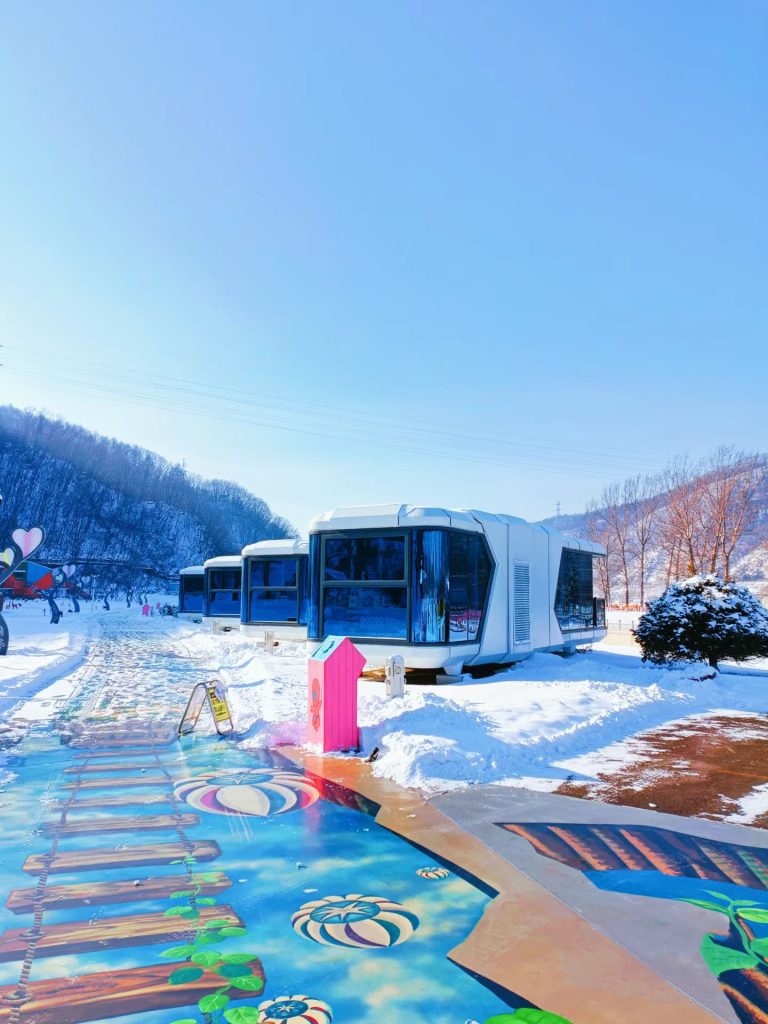
One of the most common questions about space capsule homes is simple: Will it hold up where I want to put it?
Whether you’re dreaming of a desert retreat, a mountain cabin, a coastal getaway, or a forest hideaway — your capsule needs to handle the local climate.
In this post, we’ll break down how a space capsule home performs in four extreme climate scenarios: desert heat, arctic cold, humid tropics, and high-wind coastal zones.
What Makes a Space Capsule Climate-Ready?
Before we dive into specific climates, let’s look at the features that help Luban Cabin handle almost any environment:
| Feature | Climate Benefit |
|---|---|
| Aerospace-grade aluminum shell | No rust, no rot, no termites |
| 50mm+ insulation (polyurethane/rockwool) | Keeps heat out in summer, in during winter |
| 6-layer waterproofing system | No leaks, no moisture penetration |
| S-Cut interlocking structure | Airtight seals, no drafts |
| Curved aerodynamic shape | Sheds wind and snow |
| B1 fireproof insulation | Self-extinguishing in wildfire zones |
Now let’s put them to the test.
Climate 1: Desert Heat (Arizona, Sahara, Middle East)
Challenges:
- Daytime temps: 100°F–120°F+ (38°C–49°C+)
- Intense UV radiation
- Extreme temperature swings (hot days, cold nights)
- Sand and dust
How a Space Capsule Handles It:
| Challenge | Solution |
|---|---|
| Extreme heat | 50mm+ insulation slows heat transfer |
| UV damage | Aerospace aluminum resists UV degradation |
| Night cold | Insulation retains daytime heat |
| Sand/dust | S-Cut seals keep dust out |
Pro tips for desert placement:
- Park your capsule in shade (or add an awning/roof overhang)
- Install reflective window film to reduce solar gain
- Use a small mini-split AC (solar-powered) for daytime cooling
- Open windows at night for cross-breeze
Verdict: ✅ Excellent. The insulation and aluminum shell make desert living comfortable.
Climate 2: Arctic Cold (Canada, Scandinavia, Siberia)
Challenges:
- Winter temps: -20°F to -40°F (-29°C to -40°C)
- Heavy snow accumulation
- Short daylight hours
- Ice and frost
How a Space Capsule Handles It:
| Challenge | Solution |
|---|---|
| Extreme cold | 50mm+ insulation with thermal break |
| Snow load | Curved roof sheds snow naturally |
| Ice dams | Smooth surface prevents ice buildup |
| Heat loss | S-Cut structure eliminates drafts |
Pro tips for cold climate placement:
- Add a diesel or propane heater (most efficient)
- Install double-pane windows (available on upgraded models)
- Park with longest wall facing south for passive solar gain
- Use skirt insulation around the base to prevent floor heat loss
Real-world test: Luban Cabins have been installed in Siberian winter conditions (-40°C) with proper heating systems. Owners report comfortable interior temps.
Verdict: ✅ Very good. With proper heating, a space capsule home performs better than many traditional cabins.
Climate 3: Humid Tropics (Amazon, Southeast Asia, Pacific Islands)
Challenges:
- High humidity (80–100%)
- Heavy rainfall (100–400 inches/year)
- Mold, mildew, rot
- Insects (termites, ants)
- Intense sun and heat
How a Space Capsule Handles It:
| Challenge | Solution |
|---|---|
| Humidity | 6-layer waterproofing + vapor barrier |
| Rain | Curved roof + drainage channels |
| Mold/mildew | Non-porous aluminum + closed-cell insulation |
| Termites/insects | Aluminum is inedible (unlike wood) |
| Heat | Insulation + reflective shell |
Pro tips for tropical placement:
- Elevate the capsule on concrete blocks or screw piles (airflow underneath)
- Add gutters to direct rainwater away
- Install a small dehumidifier (solar-powered)
- Use mildew-resistant interior finishes
Verdict: ✅ Excellent. This is where space capsules truly shine — no rot, no termites, no mold issues that plague wood cabins.
Climate 4: High-Wind Coastal Zones (Hurricane Belt, Patagonia, UK Coast)
Challenges:
- Hurricane-force winds (100–150+ mph)
- Salt spray (corrosion)
- Storm surges (flooding risk)
- Flying debris
How a Space Capsule Handles It:
| Challenge | Solution |
|---|---|
| High winds | Aerodynamic curved shape reduces wind load |
| Salt corrosion | Aluminum is naturally corrosion-resistant |
| Flying debris | Sturdy aluminum shell (stronger than wood siding) |
| Flooding | Can be elevated on piers (like beach houses) |
Pro tips for coastal placement:
- Anchor the capsule to a concrete foundation (not just gravel pad)
- Install hurricane-rated tie-downs
- Elevate on stilts/posts if in flood zone
- Use stainless steel hardware for exterior attachments
Verdict: ✅ Good. While not rated for Category 5 hurricanes without anchoring, a space capsule home handles coastal conditions better than wood-frame construction.
Quick Reference: Climate Performance Scorecard
| Climate | Insulation | Waterproof | Corrosion | Wind/Snow | Overall |
|---|---|---|---|---|---|
| Desert Heat | ⭐⭐⭐⭐⭐ | ⭐⭐⭐⭐ | ⭐⭐⭐⭐⭐ | ⭐⭐⭐⭐ | 5/5 |
| Arctic Cold | ⭐⭐⭐⭐⭐ | ⭐⭐⭐⭐⭐ | ⭐⭐⭐⭐⭐ | ⭐⭐⭐⭐⭐ | 5/5 |
| Humid Tropics | ⭐⭐⭐⭐ | ⭐⭐⭐⭐⭐ | ⭐⭐⭐⭐⭐ | ⭐⭐⭐⭐ | 5/5 |
| Coastal Winds | ⭐⭐⭐⭐ | ⭐⭐⭐⭐ | ⭐⭐⭐⭐ | ⭐⭐⭐⭐ | 4/5 |
What About Fire Risk? (Wildfire Zones)
In addition to the four climates above, many buyers ask about wildfire-prone areas (California, Australia, Mediterranean).
Space capsule advantage:
- B1 fireproof insulation (self-extinguishing)
- Aluminum shell doesn’t burn (unlike wood)
- No wood framing to fuel a fire
Verdict: ✅ Better than wood cabins. Still requires clearing vegetation around the capsule (standard fire safety).
The Bottom Line
A space capsule home isn’t just a futuristic design — it’s a climate-resilient structure built to perform in extreme conditions.
| Climate | Can a Space Capsule Handle It? |
|---|---|
| Desert (120°F+) | ✅ Yes |
| Arctic (-40°F) | ✅ Yes (with heater) |
| Humid tropics | ✅ Yes |
| Coastal high-wind | ✅ Yes (with anchoring) |
| Wildfire zone | ✅ Yes (fireproof materials) |
No structure is perfect for every environment. But the Luban Cabin’s combination of aluminum, insulation, and waterproofing makes it one of the most versatile prefab homes on the market.
👉 Ready to place a space capsule home in your dream location? Luban Cabin performs in any climate. Contact us to discuss your site conditions.