
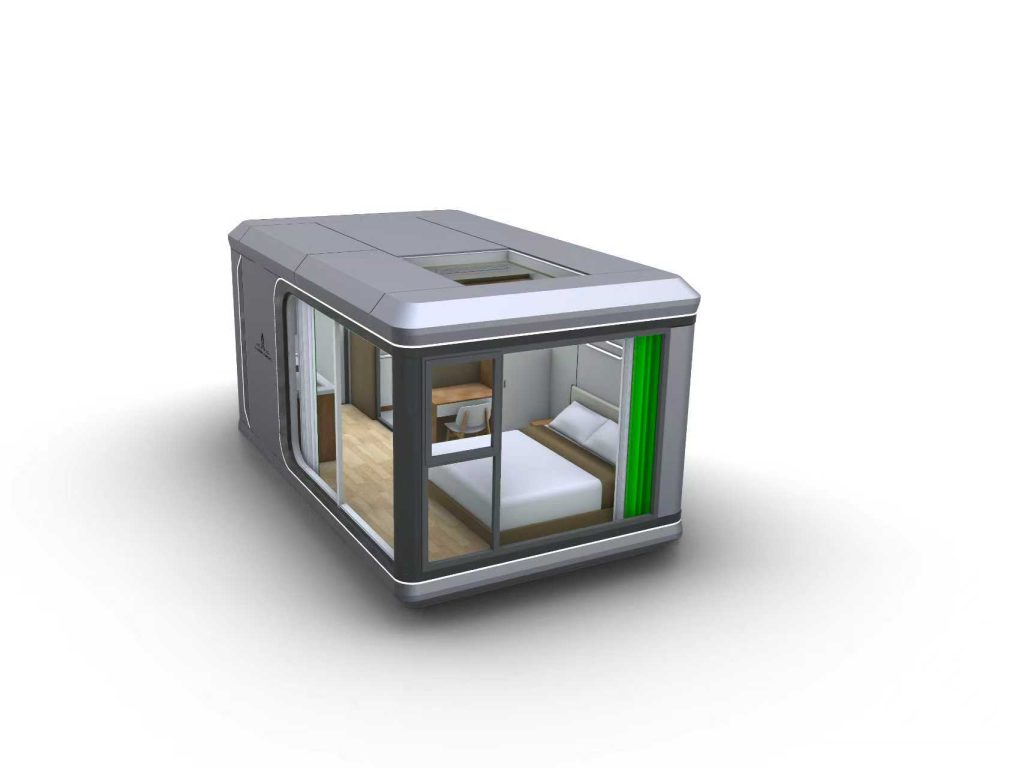
At first glance, a space capsule house and a shipping container home might look similar. Both are compact, prefabricated, and often used for alternative living.
But once you look closer, the differences are massive.
In this post, we’ll break down the space capsule vs shipping container debate — and show you why Luban Cabin comes out on top.
What Is a Shipping Container Home?
A shipping container home is exactly what it sounds like: a steel cargo container (typically 20ft or 40ft) converted into a living space.
Pros:
- Cheap and widely available
- Stackable for multi-story designs
- Strong steel structure
Cons:
- Poor insulation (steel conducts heat and cold)
- Rust and corrosion over time
- Narrow and boxy layout
- Difficult to cut windows and doors
- Requires extensive modification to be livable
What Is a Space Capsule House?
A space capsule house (like Luban Cabin) is purpose-built for living — not repurposed from cargo.
Pros:
- Designed for human comfort from day one
- Aerospace-grade aluminum shell (lightweight, no rust)
- 6-layer waterproofing + fireproof insulation
- Panoramic curved windows
- Pre-installed electrical and plumbing
- Ready to use upon delivery
Cons:
- Higher upfront cost than a raw container
- Less widely known (still emerging market)
Head-to-Head Comparison: Space Capsule vs Shipping Container
| Feature | Shipping Container | Space Capsule (Luban Cabin) |
|---|---|---|
| Purpose-built for living | ❌ No (repurposed cargo) | ✅ Yes |
| Insulation | ❌ Poor (requires add-on) | ✅ Pre-installed (fireproof + thermal) |
| Waterproofing | ❌ Single layer (prone to leaks) | ✅ 6-layer system |
| Rust resistance | ❌ Steel rusts over time | ✅ Aluminum (no rust) |
| Weight | Heavy (3,500+ lbs for 20ft) | Lightweight (1.5 tons total) |
| Window options | ❌ Limited (structural weakness) | ✅ Panoramic curved windows |
| Interior finish | ❌ Requires full build-out | ✅ Pre-installed |
| Electrical/plumbing | ❌ Must be added | ✅ Pre-run |
| Delivery time | Fast (container available) | 1-2 months production |
| Move-in ready | ❌ No (needs months of work) | ✅ Yes (connect utilities) |
The Livability Factor
This is the most important difference.
A shipping container is designed to stack on a cargo ship — not for humans to live in. It’s narrow (8ft wide), dark, and turns into an oven in summer or a freezer in winter without expensive modifications.
A space capsule house is designed from the ground up for comfortable living. The curved walls, panoramic windows, and proper insulation make it feel spacious and habitable year-round.
“A shipping container is a box. A space capsule is a home.”
Cost Comparison: Don’t Be Fooled by the Sticker Price
A used shipping container might cost only $2,000–$5,000. But that’s just the start.
To make a container livable, you’ll need:
- Insulation: $3,000–$8,000
- Windows and doors: $2,000–$5,000
- Electrical and plumbing: $3,000–$7,000
- Interior finishes: $5,000–$10,000
- Rust treatment and painting: $1,000–$3,000
Total container conversion cost: $16,000–$38,000+
A Luban Cabin arrives already finished for $20,000–$40,000 all-in. The price difference is much smaller than it first appears — and you save months of construction time.
Which One Should You Choose?
| If you want… | Choose… |
|---|---|
| Lowest possible upfront cost (and don’t mind DIY) | Shipping container |
| Move-in ready, no construction work | Space capsule |
| Rust-proof, long-term durability | Space capsule |
| Panoramic views and natural light | Space capsule |
| Off-grid capability | Both (but capsule comes ready) |
| Stackable multi-story design | Shipping container |
The Bottom Line
In the space capsule vs shipping container comparison, the space capsule wins for most buyers — especially if you value comfort, time, and simplicity.
Shipping containers make sense for budget DIY projects or industrial-style designs. But for a true prefab home that’s ready to live in from day one, Luban Cabin’s space capsule is the smarter choice.
👉 Ready to skip the container hassle? Luban Cabin delivers a move-in ready space capsule home — no welding, no insulation headaches, no months of waiting.